

The Kenyan materials engineer and founder of Gjenge Makers is transforming discarded plastic into durable construction products—demonstrating how African innovation can address pollution, manufacturing and employment at the same time.
Where many people see a pile of discarded plastic, Nzambi Matee sees raw material.
The Kenyan materials engineer, inventor and entrepreneur is the founder of Gjenge Makers, a Nairobi-based social enterprise turning plastic waste into paving blocks, tiles and other construction products.
Her innovation responds to two important needs at once.
Kenya’s communities need practical and affordable construction materials. They also need better ways to manage the plastic waste accumulating in streets, dumping areas and the wider environment.
Nzambi brought those challenges together and asked a powerful question: What if some of the plastic being thrown away could be given a commercially useful second life?
The answer became Gjenge Makers.
By combining engineering, locally developed machinery and sustainable manufacturing, Nzambi has created a business that demonstrates how waste can become infrastructure—and how an environmental challenge can inspire employment, enterprise and new possibilities.
The Engineer Who Refused to Remain on the Sidelines
Nzambi’s journey began with frustration at the amount of plastic waste she saw accumulating around Nairobi.
Plastic is used throughout modern life because it is lightweight, versatile and relatively affordable. But those same qualities become a serious environmental problem when discarded materials are not collected or processed properly.
Much of the waste can remain in the environment for years, blocking drainage systems, polluting communities and creating risks for people and wildlife.
Nzambi decided she wanted to participate directly in developing a solution.
“I was tired of being on the sidelines,” she said while explaining what motivated her to establish Gjenge Makers.
That decision transformed her from an observer of the plastic-waste problem into an engineer building a practical response.
She began experimenting with ways to combine selected plastic waste with sand and convert the mixture into durable paving products. The work required her to understand the behavior of different materials, determine suitable ratios and develop machinery capable of supporting production.
Her response was not simply to collect waste. It was to increase its value.
From Discarded Plastic to Construction Material
Gjenge Makers works with selected forms of plastic waste that can be processed into construction products.
The plastic is sorted and prepared before being combined with sand. The mixture is heated and compressed into paving blocks in different shapes, colors and thicknesses.
Plastic acts as a binding material within the product, helping create a strong and durable finished paver.
The company has developed products for different applications, including pedestrian walkways and areas requiring heavier-duty paving.
This process gives discarded plastic a new purpose.
Instead of remaining waste, it becomes part of a useful product that can improve compounds, walkways, schools, homes and commercial environments.
Nzambi also helped design the machinery and production systems used by the company. That aspect of her work is especially significant because it demonstrates that Kenyan innovation does not have to stop at the idea stage.
She developed both the material and the means of manufacturing it.
Building the Machines Behind the Vision
A strong product requires a reliable production process.
Nzambi’s materials-engineering background allowed her to approach plastic waste as a technical challenge. She needed to understand which types of plastic could be used, how they would behave when combined with sand and how the mixture could be shaped consistently.
She designed machinery to support that process, turning an experimental idea into a manufacturing operation.
The development of locally appropriate equipment is an important part of the Gjenge Makers story.
Many promising environmental ideas struggle to move beyond small demonstrations because the machinery required for large-scale production is expensive or inaccessible.
Nzambi’s decision to develop the production system helped give the concept commercial potential.
It meant Gjenge Makers could do more than show that a plastic paver was possible. The company could begin producing construction materials for actual customers and projects.
Strong Products From an Unlikely Material
Gjenge Makers describes its recycled-plastic products as durable alternatives to conventional paving materials.
According to the company, its lighter-duty plastic pavers have recorded high compressive strength, while also offering the visual flexibility of different colors and designs. Gjenge Makers presents the products as part of its mission to “build alternatively, affordably and sustainably.”
The company produces paving blocks and paving tiles for different uses.
Their strength illustrates one of the most important principles behind circular manufacturing: a product made from waste does not have to feel temporary or inferior.
Environmental responsibility becomes more attractive when the sustainable option also performs well.
Customers selecting paving materials need products capable of withstanding pressure, weather and continued use. Gjenge Makers therefore has to compete not only through its environmental story but also through the quality of what it manufactures.
That combination—purpose and performance—is what gives the enterprise its wider potential.
A New Life for Difficult Plastic Waste
Not every type of plastic can be processed in the same way.
Gjenge Makers has worked with materials such as high-density polyethylene, low-density polyethylene and polypropylene. These plastics can be found in common items such as containers, packaging, bags, ropes, lids and buckets.
Some of this waste may no longer be suitable for conventional recycling streams.
By turning selected discarded plastics into construction products, Gjenge Makers helps extend the useful life of the material.
This does not eliminate the need to reduce unnecessary plastic consumption or improve waste-management systems. It provides an additional pathway for materials that already exist and might otherwise remain in the environment.
The idea is simple but powerful: waste should not automatically be treated as useless.
With the right knowledge, machinery and market, it can become an input for a different industry.
Recognized by the United Nations
Nzambi’s work received international recognition when the United Nations Environment Programme named her a 2020 Young Champion of the Earth for Africa.
The award recognizes young environmental innovators developing ambitious solutions to major global challenges.
UNEP highlighted Nzambi’s work as an example of local innovation responding to plastic pollution while producing useful construction materials. It described her as a materials engineer and head of Gjenge Makers, building a more sustainable approach to Nairobi’s waste and infrastructure challenges. United Nations Environment Programme
The recognition gave international visibility to both Nzambi and the possibilities emerging from Kenyan environmental entrepreneurship.
It also placed her work within a larger global movement toward a circular economy—one in which products and materials are kept in use for longer instead of being discarded after a single life cycle.
Nzambi’s achievement sent a clear message: some of the world’s most practical environmental ideas are being developed by young African innovators who understand their communities and are willing to build solutions locally.
More Than Recycling
Gjenge Makers is often introduced as a recycling company, but its work extends beyond waste collection.
It is also a manufacturing enterprise.
The company acquires or receives plastic, prepares the material, combines it with sand, operates production machinery and creates finished products for the construction market.
This distinction matters.
Recycling becomes more economically sustainable when the recovered material can be transformed into a product people genuinely need and are prepared to purchase.



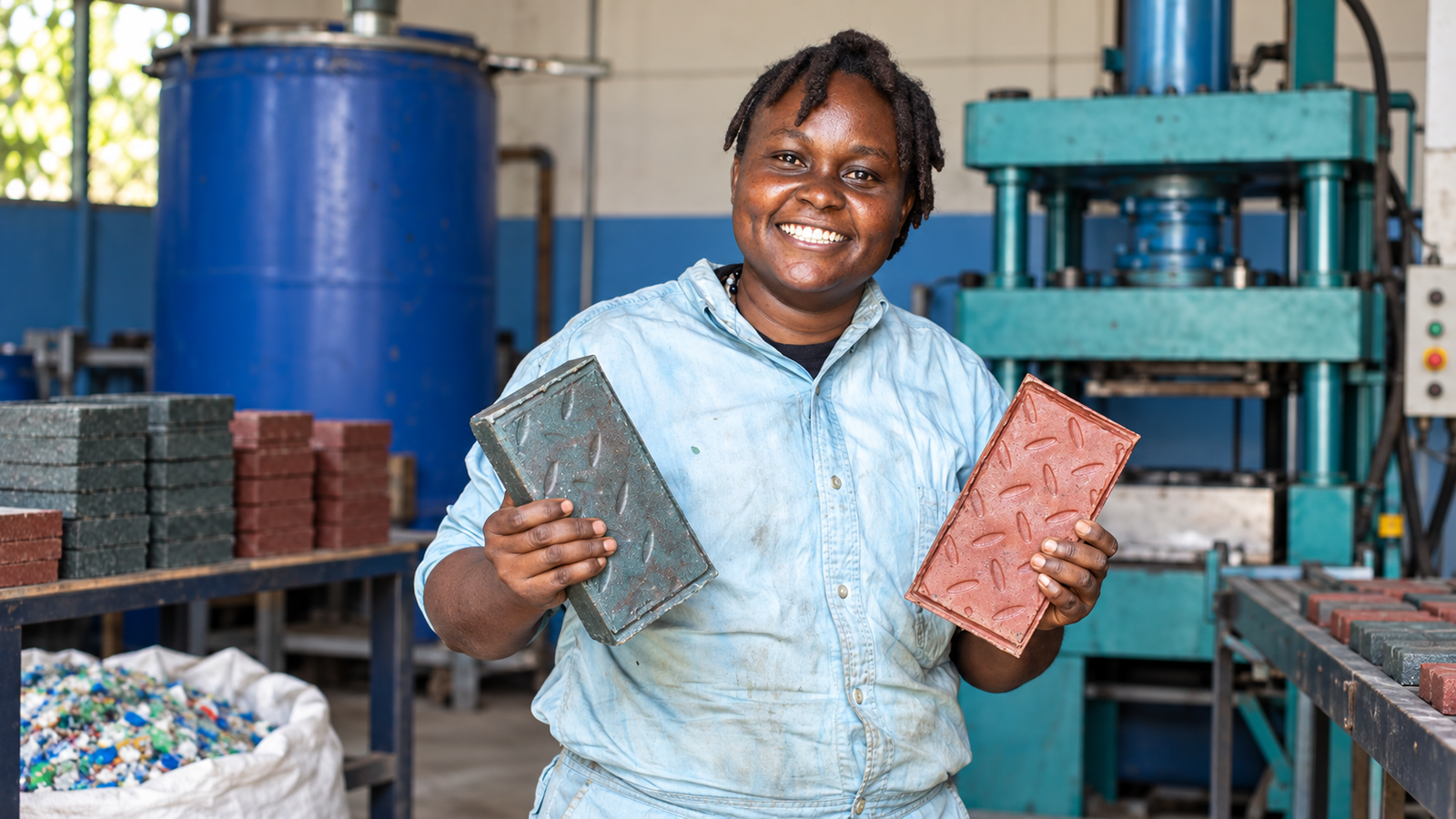
Gjenge Makers is connecting the waste-management sector with the construction industry.
On one side are factories, collectors and communities with discarded plastic. On the other are homeowners, schools, businesses and developers seeking paving materials.
The company creates value by building a bridge between the two.
Creating Opportunities Through Green Manufacturing
The Gjenge Makers model also creates opportunities for people working across its supply and production chain.
Plastic must be collected, sorted, transported and prepared. Machinery must be operated and maintained. Finished pavers must be marketed, sold and installed.
The company says it has recycled more than 200,000 kilograms of plastic waste and created approximately 600 opportunities for women, youth groups and waste collectors through its work and wider network. These are current company-reported figures published on the Gjenge Makers website.
This employment dimension is central to the company’s social-enterprise identity.
Plastic pollution is an environmental problem, but waste recovery can also become a source of income when properly organized.
Young people and women can participate in collection, sorting, production, sales, installation and other parts of the value chain.
The result is an enterprise that does not only remove waste. It helps demonstrate how environmental action can support livelihoods.
Making Sustainability Visible
One advantage of turning plastic into paving blocks is that the environmental solution becomes visible in everyday life.
A finished walkway, courtyard or compound gives discarded material a new public identity.
People can walk across an attractive paved surface and understand that some of the material beneath their feet once existed as plastic waste.
That visibility can change how communities think about recycling.
Waste management is often discussed through statistics, warnings and distant environmental consequences. A recycled-plastic paver makes the idea tangible.
It shows that responsible material recovery can produce something useful, durable and visually appealing.
Each installation becomes a small demonstration of what a circular economy can look like.
Supporting More Sustainable Construction
Construction consumes large quantities of raw materials and produces significant environmental impacts.
As towns and cities grow, the demand for homes, schools, commercial properties, roads and public spaces also increases.
Sustainable construction requires innovators to consider how materials are sourced, manufactured, transported, installed and eventually reused or disposed of.
Gjenge Makers contributes to that conversation by introducing recycled plastic into selected paving applications.
The company’s products are not intended to solve every construction challenge. Their importance lies in showing that alternative materials can become part of the industry.
A compound paved with recycled-plastic blocks may represent only one project, but many similar projects can divert substantial quantities of waste while increasing demand for sustainable manufacturing.
Nzambi’s work encourages developers, institutions and homeowners to consider environmental impact when selecting materials.
Engineering With Local Challenges in Mind
Nzambi’s innovation reflects the value of developing solutions close to the problem.
She encountered plastic waste in Nairobi, understood the local need for construction materials and created a product that connects the two.
This proximity helped shape a practical response.
African innovation is sometimes discussed as though the continent is waiting for solutions to arrive from somewhere else. Nzambi’s work tells a different story.
Kenyan engineers and entrepreneurs are capable of designing machinery, testing materials, developing products and building companies around challenges experienced in their own communities.
Local innovation also has the advantage of context.
The people developing the product understand the available materials, customer needs, economic realities and environmental conditions surrounding its use.
Gjenge Makers is therefore more than a company producing pavers. It is an example of locally driven industrial problem-solving.
From Prototype to Production
Many powerful ideas begin as experiments.
The difficult step is moving from an early prototype to a reliable product that can be manufactured repeatedly.
Nzambi had to test combinations of plastic and sand, evaluate product performance and develop machinery capable of producing pavers consistently.
She also had to build a business around the invention.
That meant sourcing material, organizing production, finding customers and communicating why a recycled-plastic paver deserved a place in the construction market.
Her journey demonstrates that innovation requires more than inspiration.
It demands technical knowledge, persistence and the willingness to solve one operational problem after another.
The finished paver may look simple. Behind it is a process involving engineering, manufacturing, waste recovery and entrepreneurship.
Women Building Kenya’s Industrial Future
Nzambi’s story is also significant because it places a young Kenyan woman at the center of engineering and manufacturing.
Women remain underrepresented in many technical and industrial sectors. Visible founders such as Nzambi can help expand the way young people imagine who can become an engineer, inventor or manufacturing executive.
Her work shows that environmental entrepreneurship is not limited to advocacy or awareness campaigns.
Women can design machines, develop materials, manage factories and introduce new products into the construction industry.
For girls interested in science, technology, engineering and mathematics, Nzambi’s journey provides a powerful example.
Technical education can become a tool for addressing visible community problems—and an idea developed in a local workshop can attract international recognition.
Why Nzambi Matee’s Story Matters
At Sisi Kenya Spotlight, we celebrate Kenyans who see possibilities where others may see limitations.
Nzambi Matee’s story matters because she looked at a difficult environmental problem and imagined a productive second life for the material at its center.
She did not approach plastic waste only as something to be removed. She treated it as an engineering resource.
Through Gjenge Makers, she has connected waste recovery with manufacturing, construction and employment.
Her work represents the kind of innovation Kenya needs: locally informed, commercially useful and capable of producing wider social and environmental value.
It also reminds us that sustainability becomes more powerful when it is built into products people can use every day.
Building Change, One Paver at a Time
Nzambi Matee is helping rewrite the story of Nairobi’s discarded plastic.
In the old story, plastic is used, thrown away and left to pollute the environment.
In the story being built by Gjenge Makers, selected plastic is collected, processed and returned to the economy as a durable construction product.
That transformation captures the promise of the circular economy.
Materials do not have to reach the end of their usefulness simply because their first purpose is complete. With innovation, they can enter a new production cycle and serve a completely different need.
Nzambi has turned that principle into a Kenyan manufacturing enterprise.
Every paving block carries part of the story: the discarded material, the engineer who saw its potential, the machinery built to process it and the people whose work gave it a second life.
Through Gjenge Makers, Nzambi is not only building pathways and compounds.
She is building a greener vision of Nairobi—one recycled-plastic paver at a time.